
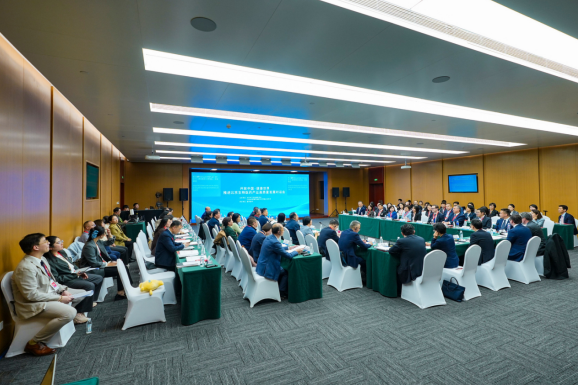
As one of the featured thematic sessions in the “Dual Exhibition” series, the “Open China, Healthy World: Dialogue on Advancing High-Quality Development of Beijing’s Biopharmaceutical Industry” was held in Beijing on October 21. The dialogue was jointly organized by the Beijing Municipal Health Commission and the Pharmaceutical Research and Manufacturers of America (PhRMA). Shu Bilei, Deputy Secretary-General of the Beijing Municipal People’s Government, attended the event and delivered concluding remarks. Focusing on the goals of the Healthy China Initiative, the dialogue served as a bridge for communication and cooperation between China, Beijing and the rest of the world, fostering the exchange and integration of global pharmaceutical innovation resources.
Participants held in-depth discussions on topics including the contribution of the biopharmaceutical industry to Beijing’s high-quality development, global innovation trends and international experience, and policy recommendations for improving Beijing’s innovation ecosystem. They noted that China has become a major force in global pharmaceutical innovation and that Beijing is emerging as a key hub connecting China with global innovation. Representatives from enterprises also put forward suggestions on accelerating the adoption of innovative achievements in medical institutions and making them more accessible to patients. Officials from the Beijing Municipal Health Commission, Beijing Municipal Medical Insurance Bureau, Beijing Municipal Medical Products Administration and Beijing Municipal Intellectual Property Office, together with heads of participating medical institutions, responded to the concerns raised by enterprises. They outlined the city’s policy measures and progress in supporting the high-quality development of innovative medicines, and pledged to provide enterprises with comprehensive support throughout the innovation process.
In his concluding remarks, Shu Bilei said that the suggestions raised by enterprises would be carefully reviewed and studied, incorporated into next year’s policy measures to support the high-quality development of innovative medicines, and translated into concrete action. He noted that Beijing has the country’s highest concentration of pharmaceutical innovation talent, high-quality medical resources and regulatory resources. The city is home to nearly half of the country’s national medical centers and national clinical research centers, while principal investigators (PIs) leading international multicenter clinical trials in Beijing account for 40 percent of the national total. These strengths make Beijing a preferred destination for pharmaceutical innovation companies seeking to establish and expand their presence. Beijing will continue to improve its biopharmaceutical innovation ecosystem and multi-tiered payment and reimbursement system, helping innovative achievements reach patients more quickly.
The dialogue gave the international community a more direct understanding of China and Beijing, while creating a new platform for Beijing’s biopharmaceutical industry to align with the world and become more deeply integrated into global innovation networks. Beijing will continue to expand high-level opening-up, foster an environment conducive to innovation and cooperation, and build a world-class business environment that is market-oriented, law-based and internationalized. The city will accelerate its development into a leading hub for innovative medicines and a center for attracting talent, bringing global innovation resources to Beijing and ensuring that innovative achievements benefit patients around the world. In doing so, Beijing will contribute its strength to building a global community of health for all.
The event was attended by principal officials from the Beijing Municipal Health Commission, Beijing Municipal Medical Insurance Bureau, Beijing Municipal Medical Products Administration and Beijing Municipal Intellectual Property Office; heads of 12 medical institutions in Beijing, including Peking University People's Hospital, Peking University Cancer Hospital and Beijing Tiantan Hospital; PhRMA’s Senior Vice President for International Policy and Chief Representative of its China Office; and senior executives from nine multinational biopharmaceutical companies, including AstraZeneca, Sanofi and Pfizer.