
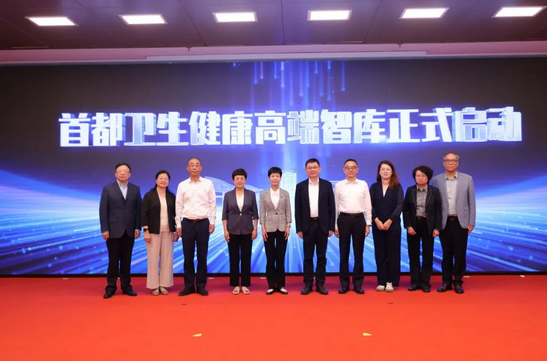
On September 8, the launch meeting and joint working conference of the Capital Health and Wellness High-End Think Tank was held at Peking University Health Science Center, marking its official establishment. At the meeting, the Beijing Municipal Health Commission and Peking University Health Science Center signed the Strategic Cooperation Agreement on Health Management and Policy. It is reported that the Capital Health and Wellness High-End Think Tank is the only high-end think tank in Beijing focusing on health and wellness, which is supervised and hosted by Peking University, guided by the Beijing Municipal Health Commission, and supported by the Peking University Institute for Capital Health Development, with approval from the Beijing Municipal Committee.
Attendees included Guo Yanhong, member of the Party Leadership Group and Deputy Director of the National Health Commission, Zhong Dongbo, Party Secretary of the Beijing Municipal Health Commission, Zhai Degang, Party Secretary and Executive Vice President of the Beijing Federation of Social Science Circles and Director of the Municipal Office of Social Science Planning, and Qiao Jie, Executive Vice President of Peking University and Director of the Health Science Center. Officials from relevant departments of Beijing, domestic experts and scholars in health policy and management, and representatives from related departments of Peking University also attended.

The meeting acknowledged that Peking University’s designation as the construction unit of the think tank marks a major step forward in strengthening university–local government collaboration. It also represents the fruitful outcome of the research team on health policy of Peking University’s long-term research on Beijing’s health system and its extensive cooperation with the Beijing Municipal Health Commission and other government agencies. The think tank will continue to focus on major health needs of the capital, deepen collaboration between the university and local authorities, drive innovative research, and contribute wisdom and strength to building a Healthy Beijing and promoting high-quality development of health services.
The meeting emphasized that building new types of think tanks with Chinese characteristics is an urgent and significant task to promote scientific and democratic decision-making, advance modernization of the national governance system and capacity, and enhance national soft power. Since the 18th National Congress of the Communist Party of China, the CPC Central Committee with Comrade Xi Jinping at its core has placed people’s health as a strategic priority, and the fundamental and overarching role of health work in China’s modernization has become increasingly prominent. Promoting the construction of the Capital Health and Wellness High-End Think Tank is a concrete measure to implement Xi Jinping’s important instructions on building a Healthy China, and to carry out the key reform of the medical and healthcare system from the Third Plenary Session of the 20th CPC Central Committee and the Fifth Plenary Session of the 13th Beijing Municipal Committee. It is an urgent requirement for modernizing the health governance system and capacity, and a realistic need given the particularity and complexity of health work in the capital. The think tank brings together top experts and scholars from various government departments, universities, and research institutions, forming cross-departmental, cross-field, and cross-disciplinary collaborative research teams to lay the foundation for high-level policy research. It will fully leverage Peking University’s advantage as a national-level think tank, stay informed on global and national policy developments, uphold the Party’s leadership, adopt a people-centered developing approach, focus on major strategic issues in health development, and highlight the capital’s distinctive characteristics and exemplary standard. It will aim to serve as both a “brain trust” and “think tank,” producing valuable, high-quality, and actionable research to provide comprehensive intellectual support for high-quality development of health and wellness in Beijing. As the industry guidance department, the Beijing Municipal Health Commission will fully support the construction of the think tank and serve as a “liaison, coordinator, and supporter,” focusing on identifying needs, providing safeguards, and promoting the application of research findings. The Commission will support topic selection based on demand, strengthen investigation and research support, enhance participation in decision-making, and facilitate the transformation of outcomes. With the guidance of the municipal government and party committee, it will also help pool expert wisdom, build consensus on reform, and produce forward-looking and strategic research outcomes to support major municipal government decisions, promote high-quality development of health services, and lay a solid health foundation for Beijing to take the lead in achieving basic modernization.
The meeting stressed that think tanks are an important part of national soft power and a key support for the national governance and its modernization. The establishment of the Capital Health and Wellness High-End Think Tank in Beijing is of landmark significance and serves as a leading model for the national health system. It is necessary to raise political awareness, uphold a people-centered approach, serve the overall national interests, ensure high standards in building the think tank, strengthen academic foundations, improve research quality, align with real-world demands, innovate institutional mechanisms, and cultivate and attract top talent. It is also essential to improve operational mechanisms, enhance resource integration and collaborative research, accelerate the application of research findings, strengthen policy advisory capabilities, maintain a decision-oriented focus, address major issues, enhance communication with decision-making departments, improve research capacity, and cultivate talent. The meeting called for strengthening cooperation and exchanges, achieving complementary advantages, and jointly promoting the high-quality development of the health sector.