
The 14th Five-Year Plan for the Development of the Robotics Industry sets the goal that by 2025, China will become a global hub for robotic technology innovation, high-end manufacturing, and integrated applications. To identify leading, exemplary, and practical core application scenarios and solutions for medical robots, the semifinals of the 7th Science and Technology Innovation Competition (Medical Robotics Application Scenarios), guided by the Beijing Municipal Health Commission and organized by the Beijing Hospital Authority, were recently held in Beijing. Nearly 100 participating teams showcased applications of medical and general-purpose robots in clinical practice and hospital operations. Ten outstanding projects and application scenarios advanced to the finals.
The competition featured remarkable highlights including robotic applications in rehabilitation, surgery, and chronic disease care. Prototypes of intelligent patient-assistance, pharmaceutical dispensing, and traditional Chinese medicine therapy robots also demonstrated their capabilities.
According to the person in charge of the competition’s organizing committee from the Beijing Hospital Authority, the core objective of the event is to promote widespread adoption through scenario-based implementation. Specifically, a “four-step approach” was adopted: needs analysis and matching — product trial and iteration — solution development — scaled application and promotion. In selecting application scenarios, three principles were emphasized: clear identification of pain points, feasibility of the solution, and a high degree of alignment between robotic technology and application scenarios. The organizer stressed that the competition is not merely about evaluating the technical merits of robots, but about assessing the rationality and maturity of key application scenarios. This helps guide the industry’s future R&D direction and ultimately provides the public with better health services.
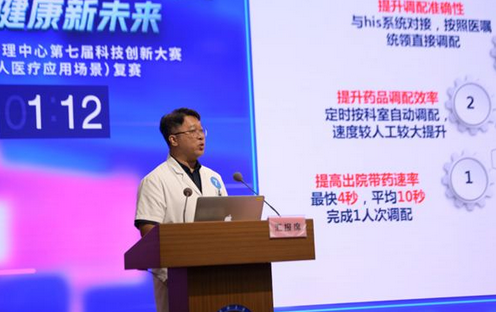
Following an extensive call for entries, 92 innovative projects from centrally-administered and municipal hospitals in Beijing were shortlisted for the semifinals. The competition was divided into two main tracks—medical robots and general-purpose robots—and further into more than ten specific application scenario categories. After rigorous competition, the following ten projects advanced to the finals: “Application Research on Embodied Intelligent Robots Based on Multimodal Large Models in Cerebrovascular Disease Ward Scenarios”, “Integrated Outpatient Pharmacy Robot for Drug Storage, Dispensing and Checking”, “Intelligent Brain Doctor”, “Medical Imaging Storage, Transmission, and Surgical Video Intelligent Collection Robotic System”, “Development and Application of Intracranial Flexible Sensor Precision Implantation Bionic Surgical Robot”, “AI Panoramic Reconstruction and Autonomous Navigation Capsule Endoscopy Robot”, “Intelligent Fracture Reduction Robotic System for Pelvic, Long Bone, Femoral Neck, and Peri-knee Osteotomy Procedures”, “Expandable Application of a Single-port Multi-degree-of-freedom Robotic Ultrasonic Scalpel in Tumor Resection (Bladder Tumor as an Example)”, “Spine Health without Boundaries: Gait Reconstruction Closed-loop Program from Hospital Ward to Home”, and “Development of Prostate Biopsy and Focal Ablation Surgical Robot”.